Overview
From the photo we can see the Sydney Harbor Bridge, one of the most photographed landmarks in Australia. A closer look from the mesh reveals the world-renowned Sydney Opera House. The project we’d like to introduce this week is Taronga Zoo Chimpanzee Enclosure in Sydney, NSW, Australia. Now let’s be prepared for the journey and see what role stainless steel plays in the Chimpanzee Exhibit.
Taronga Zoo Chimpanzee Enclosure
Taronga Zoo Chimpanzee Enclosure is situated in the suburb of Mosman, 8 kilometers north-east of the Sydney CBD. Taronga Zoo boasts Australia’s largest zoo covering 4000 animals from over 350 species. Taronga comes from the Aboriginal word meaning “beautiful view”.
Taronga Zoo was officially opened to the public in 1916, with the heritage listed Taronga Zoo Chimpanzee Exhibit added 64 years later in 1980. The Chimpanzee Enclosure constituted part of the upgrade of the 2000-square-meter Chimpanzee Exhibit, winding up with the world’s first open-paddock of its kind. Proudly speaking, it won 2011 MBA Excellence in Construction Award for Public Buildings Consultant Team management in United States, Germany, and Australia.
The Project Background of Taronga Zoo Chimpanzee Enclosure
The Taronga Zoo Chimpanzee Enclosure was a $7.5-million refurbishment project completed in late September 2011, providing new home to the 17 Taronga Zoo Chimpanzees then. The renovation was launched in response to the changing demographic of the Chimpanzee group and the modern requirements associated with zoo operations and management.
The Taronga Zoo’s chimpanzee troop constitutes one of the world’s largest captive groups characterized with complex behavior patterns and a sophisticated social hierarchy. Chimpanzees are intelligent and strong creatures, up to 7 times stronger than humans (Jackson Teece Architecture 2026). They can live up to 60+ years under zoo care in contrast with 45 years in the wild, weighing between 30KG and 60KG (Taronga.org.au 2026). The zoo cites the need for a separation enclosure so that they can easily divide the species without having to move them to an entirely new location that can cause potential commotion.
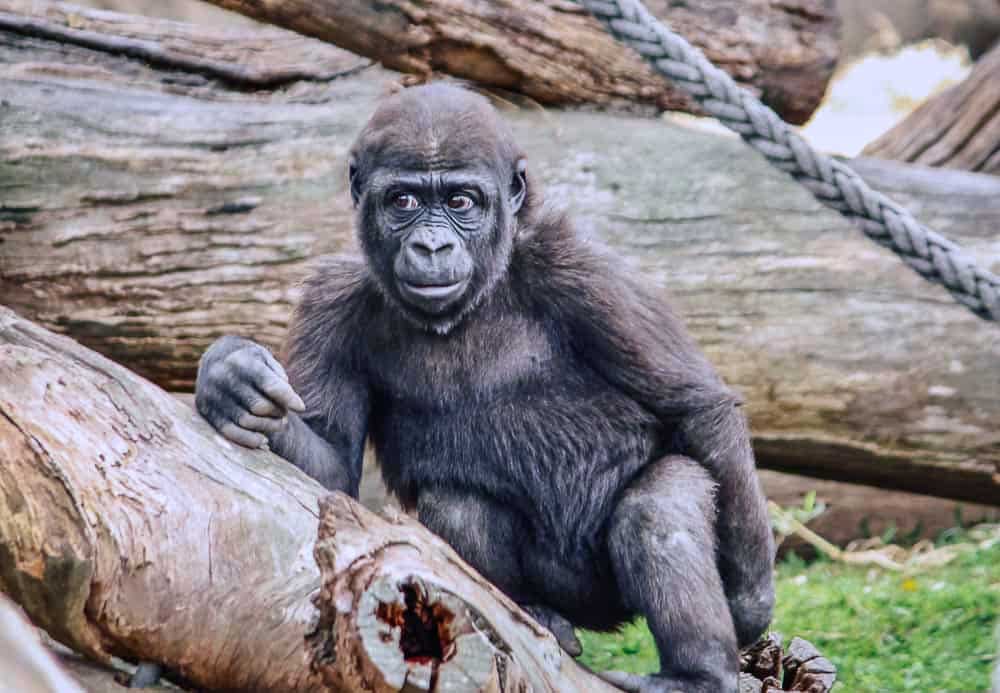
With the separation enclosure established, it helps the zoo to introduce new chimpanzee females to maintain the genetic pool while facilitating management of the current troop. It allows for the chimpanzees to remain in the range in summer unsupervised which is otherwise impossible. Above all, it maximizes viewing time for the public, which will undoubtedly enhance customer experience and increase revenues to the government who runs this zoo.
The Design of Taronga Zoo Chimpanzee Enclosure
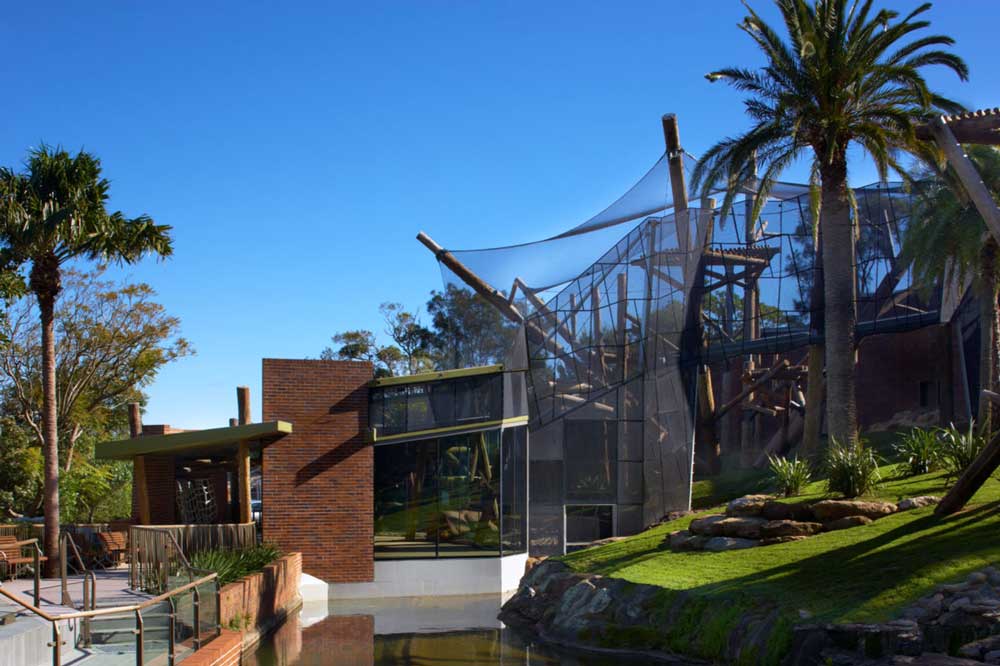
The most striking feature of the Taronga Zoo Chimpanzee Exhibit must be the new separation enclosure for it provides the chimps with the living habits experienced in the wild while keeping the species safely enclosed.
The whole structure is complex in itself, add to that there are three companies involved in designing, i.e., Ronstan Tensile Architecture, Jackson Teece and principal contractor, Lipman Pty Ltd. Through collaborative work, it winds up with a divisible “aviary-type” free-form tensile enclosure and open paddock featuring masts, cables, mesh and non-climb wall panels. 3D Model has been developed by Ronstan to ensure the complete structure is followed and the geometric intent achieved.
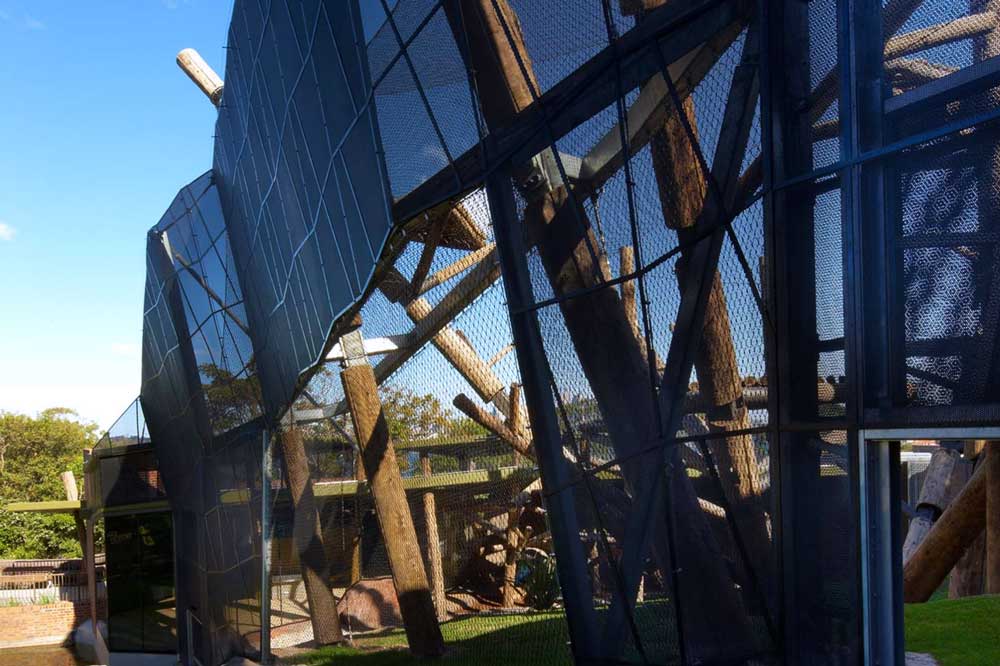
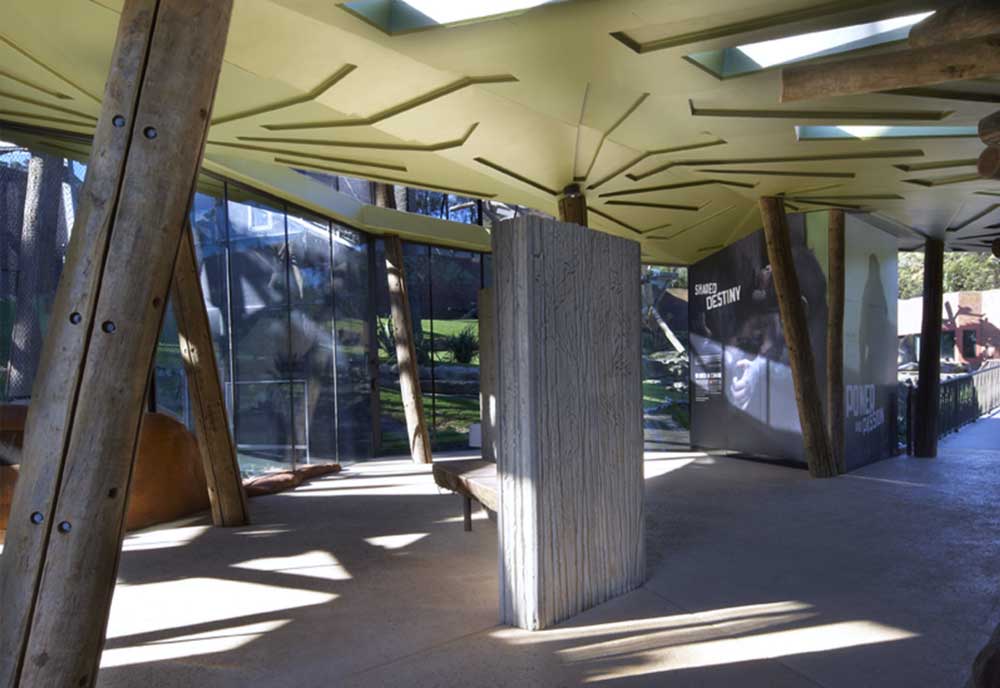
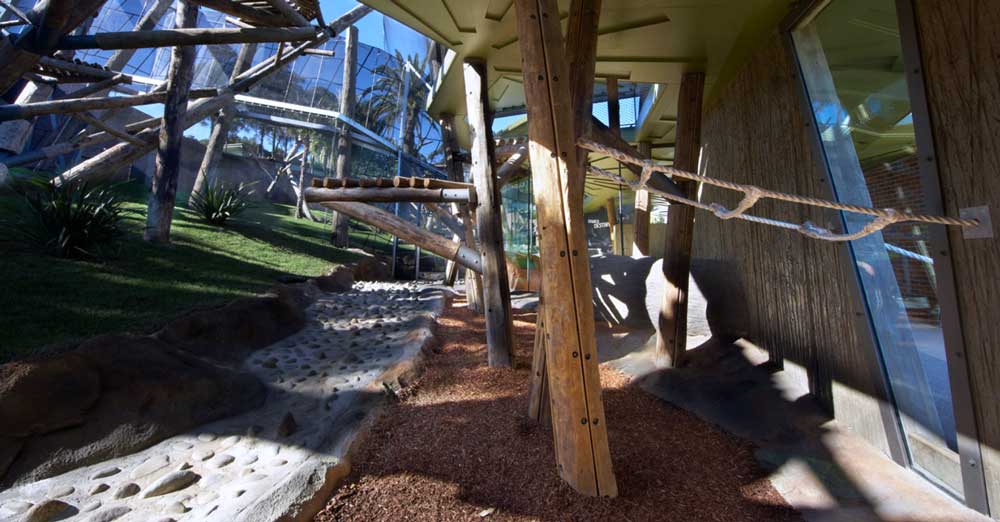
While allowing for a three dimensional climbing experience for the chimps, the new sanctuary optimizes visitor experience with immersive views by creating the illusion that the visitor has entered the domain of the Chimpanzee. Overall, the new enclosure entails three designing units, each complex on its own, combining together to create an enclosure that is safe, secure and transparent. The three units are listed as below,
• The free-form enclosure mesh and cable net.
• The masts consisted with climbing structures and footings.
• The independent non-climb cable net wall on the south/east face of the enclosure to keep chimps from climbing from the nearby paddock outside of the enclosure.
There are a lot of factors presenting themselves when it comes to design, from the height limit to the form. First with the height, the enclosure has to sit below the horizon escarpment vegetation zone and vanish behind foreground vegetation or existing buildings. The highest point cannot be higher than 12m from the ground. Second comes the built form. Despite the height limit, there should be three dimensional space sufficient for chimp well-being, climbing poles and platforms compliant with EAPA. Irregular rather than “box-like” Aviary mesh structure has to be designed to keep harmony with the surrounding tree patterns. To achieve purported mesh transparency, the structure has to be multi-faceted. At the same time, the design needs to minimize or get rid of horizontal and vertical forms. Impacts on other exhibits in the zoo should also be considered.
Stainless Steel Applied to Taronga Zoo Chimpanzee Enclosure
Material selection is vital to the Taronga Zoo Chimpanzee Enclosure, for it plays important roles in both design and function. In light of design, the blackened mesh with areas of non-climbing perforated panels needs to match the mesh, both semi-transparent. 450mm-diameter natural timbers are used as masts for chimps to climb.
The non-climbable wall (NCW) claims as the world’s first transparent cable net wall. To prevent the chimps from putting their fingers in and climbing, the wall is designed with openings of no more than 5mm and a complex 10 degree incline. The tensile cable net supporting semi-transparent panels comprises the primary structure of the NCW.
Stainless steel is chosen for its high strength, flexibility and durability. As said by Rowan Murray, GM of Ronstan, “Most materials can be damaged, but the durability of stainless steel panels of certain perforation proved to be the right solution and important in the development of the overall design.” (ASSDA 2023) Trevor Williams, Lead Consultant of Jackson Teece and Project Architect for the development, was ready to agree by saying, “The stainless steel will have a longer life in the aggressive south-facing coastal environment. The blackened mesh has a fantastic form and from an architectural point of view, has achieved an organic appearance.” (ASSDA 2023)
Stainless steel materials play key roles in the construction of the enclosure as below listed,
• Mesh enclosure. The mesh was made of 3mm grade 316 stainless steel 7 x 7 wires connected at 60mm intervals with stainless steel ferrules to form a mesh (LSAA 2026). They were painted black to maximize transparency. The total volume consumed amounted to 770m².
• Non-climbable wall façade. Grade 304 stainless steel panels in 3mm thick were perforated with 4.76 diameter holes to achieve 50.96% open area. (LSAA 2026) They were also painted in black for consistency and transparency. 140m² of perforated sheets were used in total.
• Cables & clamps. Grade 316 stainless steel cables made of 1x19 construction 8mm, 12mm and 22mm diameter were chosen for high strength and excellent performance. The stainless steel cable end fittings and components like clamps were polished and passivated prior to installation. (ASSDA 2023)
Stainless Steel from CIVMATS China
If you are looking for stainless steel perforated sheets, wire ropes and fittings, or/and wire meshes from China for your specific projects as in the case of Taronga Zoo Chimpanzee Enclosure, welcome to CIVMATS China. We can customize stainless steel grades, dimensions and shapes per your requirement. Choose CIVMATS, choose reliability and safety in China.